Cable Buyer's Guide · Video & Broadband Drops
75 Ohm RG6 Coaxial Cable: The Quiet Workhorse Behind Every Clean Picture
Shield layers, conductor materials, and the procurement details that decide whether a video drop stays sharp for a decade — or starts generating service calls next summer.
Put two quotations for the same 400-unit housing project side by side — one on standard shield RG6, one on quadshield — and the gap can easily reach 30 percent. Picking the wrong end of that spread hurts in both directions: you either pay for shielding the site will never need, or save a little now and spend the next year chasing ghosting and sparkly screens near a newly activated LTE band.
Here is the short answer. 75 ohm RG6 is the default drop cable for CATV, satellite, and broadband video because its characteristic impedance matches every F-connector, splitter, amplifier, and set-top terminal in the signal path, while an 18 AWG-class center conductor keeps attenuation in check from 5 MHz up past 1 GHz. The genuinely difficult choice is not whether to use RG6 — it is which shield construction, which conductor material, and which jacket the route demands.
Why 75 Ohms Is a System Decision, Not a Sticker Value
Characteristic impedance describes the relationship between a cable's capacitance and inductance per unit length, set by the conductor diameter, the dielectric, and the geometry of the shield. A 75-ohm rating means the cable presents the exact impedance the video and broadband industry standardized on — cameras, modulators, tuners, splitters, and wall plates are all built around it.
That match has a measurable payoff. When impedance stays uniform along the run and at every junction, signal energy transfers forward; when it does not, part of that energy reflects back toward the source. On a TV picture, reflections appear as ghosting or a sparkle pattern; on a cable modem, they surface as uncorrectable errors and slower speeds. The return loss figures on a datasheet exist precisely to quantify how well a production lot preserves the 75-ohm geometry.
Info: 75-ohm and 50-ohm cable are not interchangeable. The 75-ohm family serves video and broadband distribution, while 50-ohm cable belongs to two-way radio and RF antenna feeders. Substituting one for the other leaves every junction in the path mismatched, and no connector choice fully corrects it.
Inside the Cable: Four Layers, Four Decisions
RG6 earns its reputation in the details of its cross-section. Each layer answers a different purchasing question.
Center conductor — copper or copper-clad steel?
Most RG6 uses a solid 18 AWG conductor, roughly 1.0 mm in diameter, in either bare copper or copper-clad steel (CCS). At high frequencies, current rides the conductor's surface, so both carry RF well. The difference appears when the cable must deliver DC power — as satellite lines do when feeding an LNB. Power uses the full cross-section, and the steel core of CCS raises DC resistance over long runs, which can starve electronics at the far end. For power-passing installations, bare copper is the safer specification; for receive-only drops, CCS is a legitimate cost saving.
Dielectric — why foam beats solid
The insulation between conductor and shield is typically foamed polyethylene. Injecting gas into the polymer lowers its dielectric constant, which reduces attenuation and pushes the velocity of propagation toward 88 percent of the speed of light. A foil bonded to the foam during extrusion also keeps moisture from wicking along the interface. For the deeper physics behind this layer, see our explanation of the role of dielectric material in RG6 cable.
Shield and jacket — the environmental armor
Above the dielectric sit the foil-and-braid combinations that define the shield class, covered in the next section. The outer jacket completes the picture: standard PVC suits indoor risers, while UV-stabilized polyethylene is specified for rooftops and exterior walls. Aerial spans between buildings add a galvanized messenger wire that carries the mechanical load so the coax itself is never stretched.
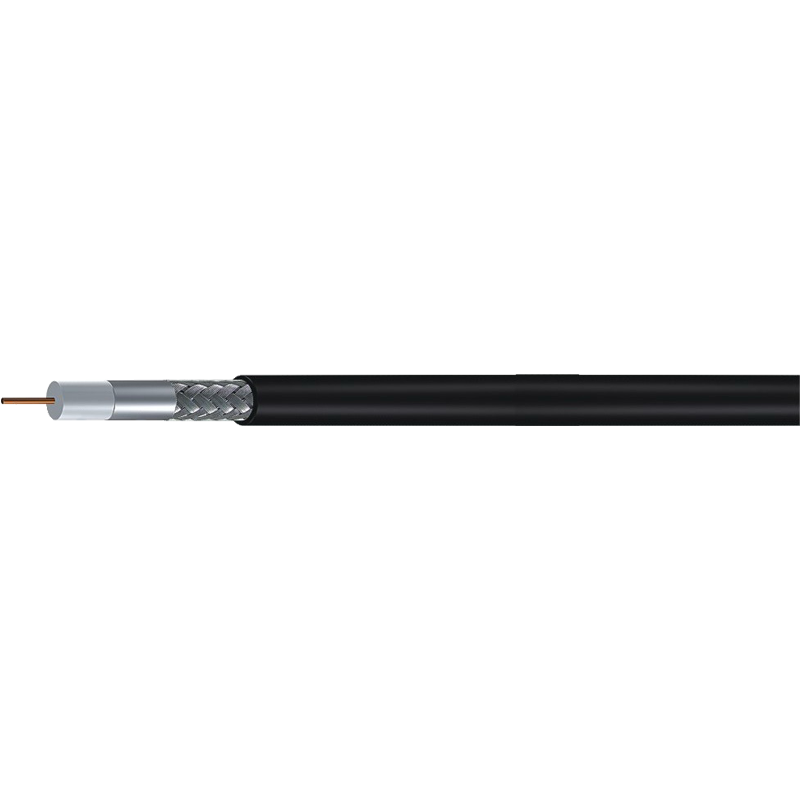
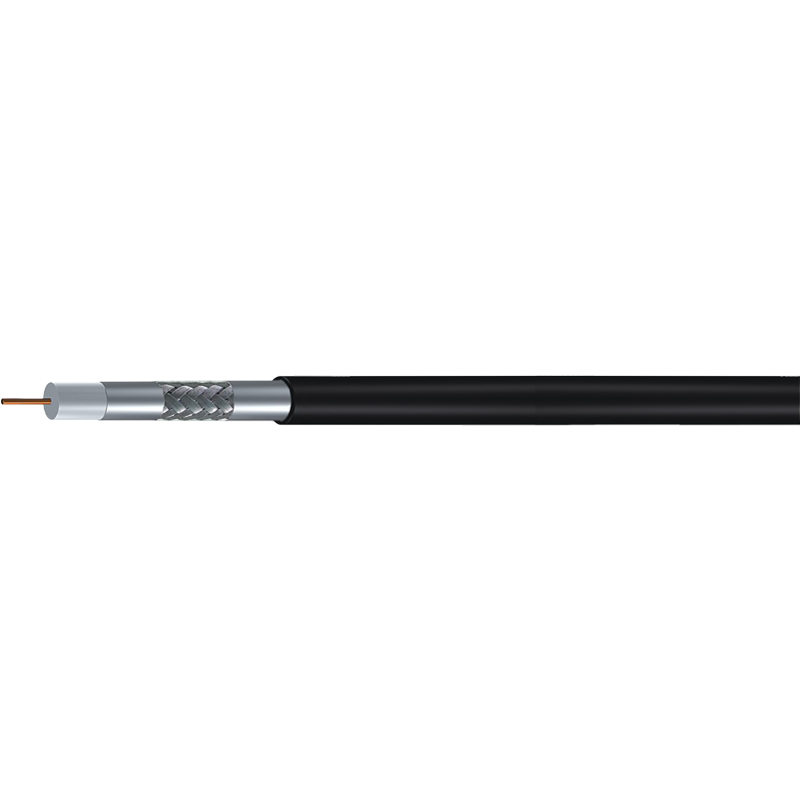
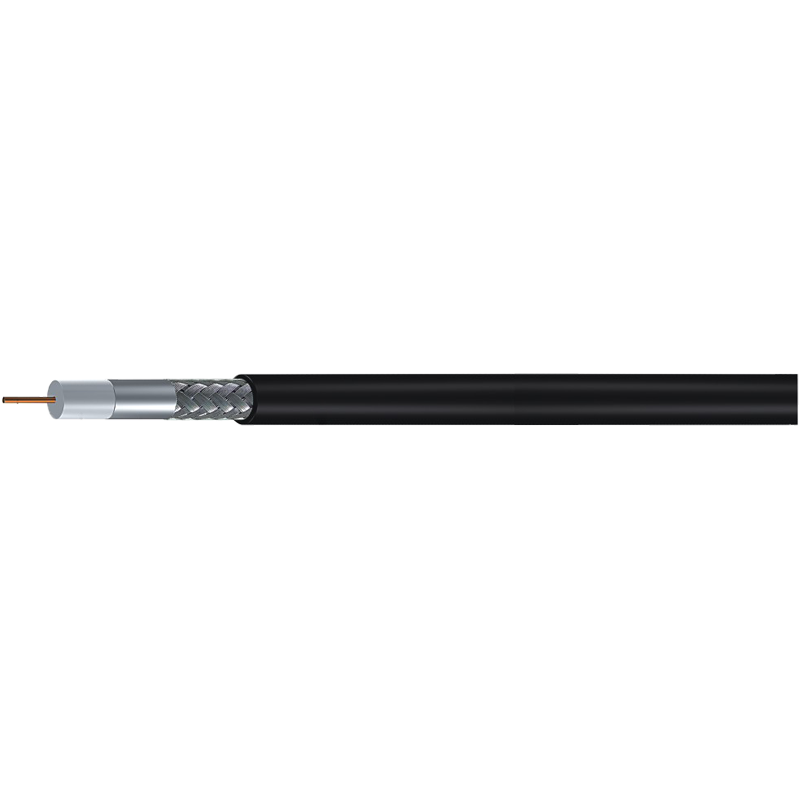 RG6 Standard Shield 75 Ohm Coaxial CableA foil-and-braid construction over gas-injected foam PE dielectric for CATV, satellite, broadband, and CCTV runs. It sets the baseline shield class against which the upgraded tri-shield and quadshield options are compared.View Product →
A coax run is only as good as its weakest boundary. Every bend, connector, and shield layer either preserves the 75-ohm geometry or quietly taxes the picture at the far end.
Standard Shield, Trishield, or Quadshield?
Shield class is where most of the price spread lives, and where most installation judgment gets applied. The three constructions differ in how many foil and braid layers sit above the dielectric.
| Shield class | Typical build | Best fit | What it protects against |
|---|---|---|---|
| Standard shield | Aluminum foil plus one braided layer | Short indoor drops in quiet RF surroundings | Basic signal ingress at the lowest cost |
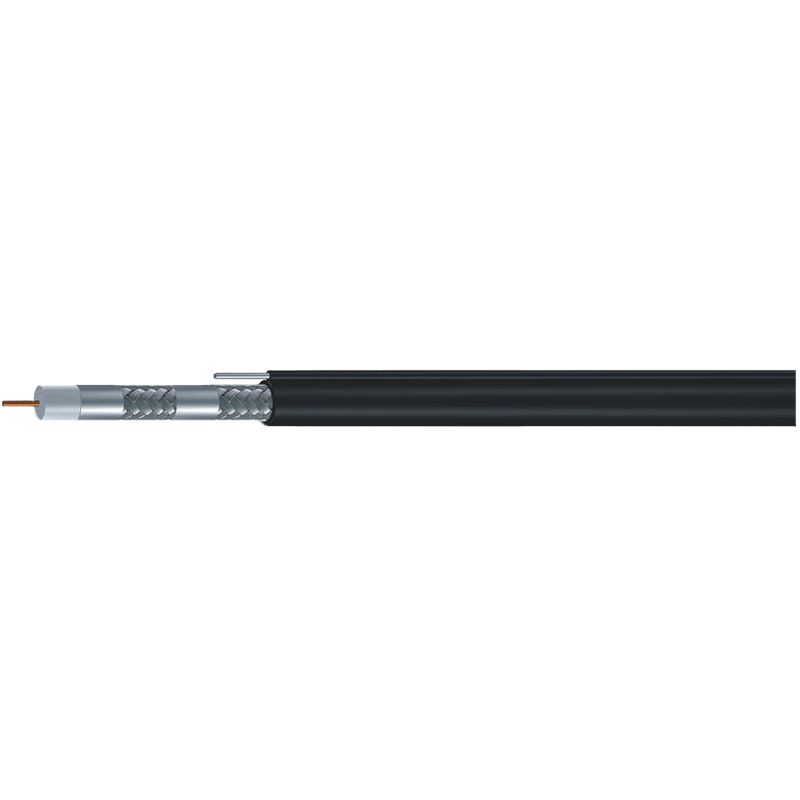
| Trishield | Two foils plus one braid | Suburban CATV and satellite drops with moderate interference | Stronger screening against LTE and broadcast noise |
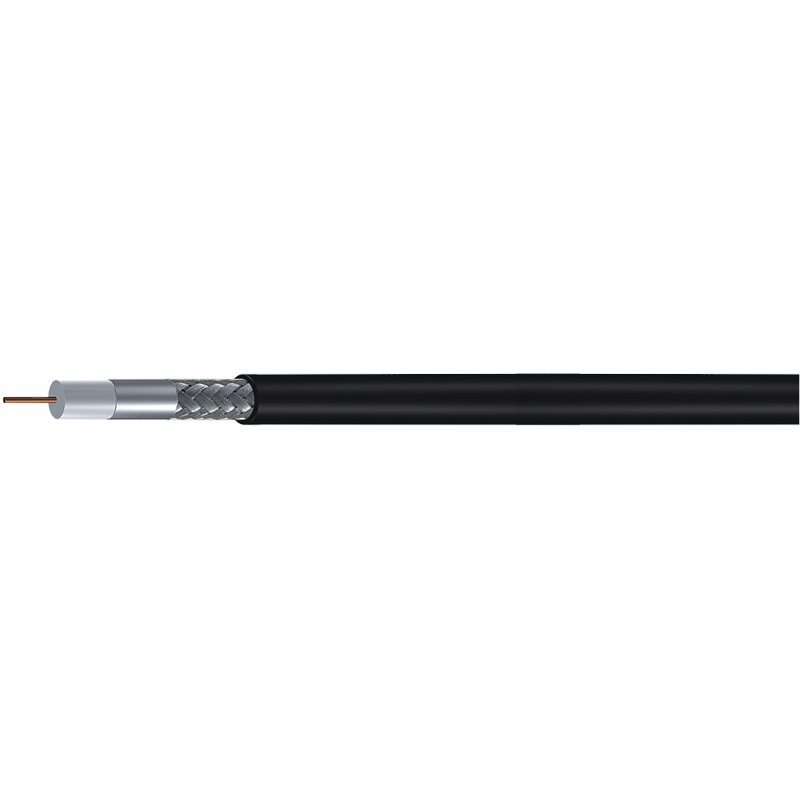
| Quadshield | Two foils plus two braids | Dense urban blocks, MDUs, sites near transmitters | The highest screening coverage in harsh RF environments |
Where the mid tier earns its premium
Trishield is the workmanlike answer for most suburban distribution. The added foil raises screening effectiveness noticeably in the frequency bands where LTE and 5G now operate, without the stiffness and cost of a full quadshield build. Once a street has produced even one interference complaint, this is the tier most installers move to.
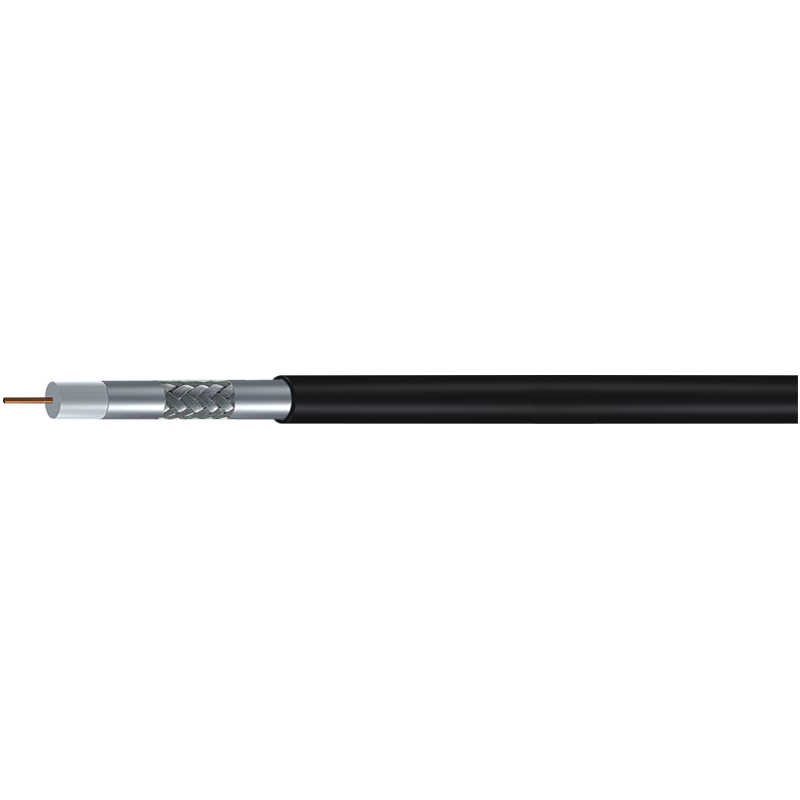
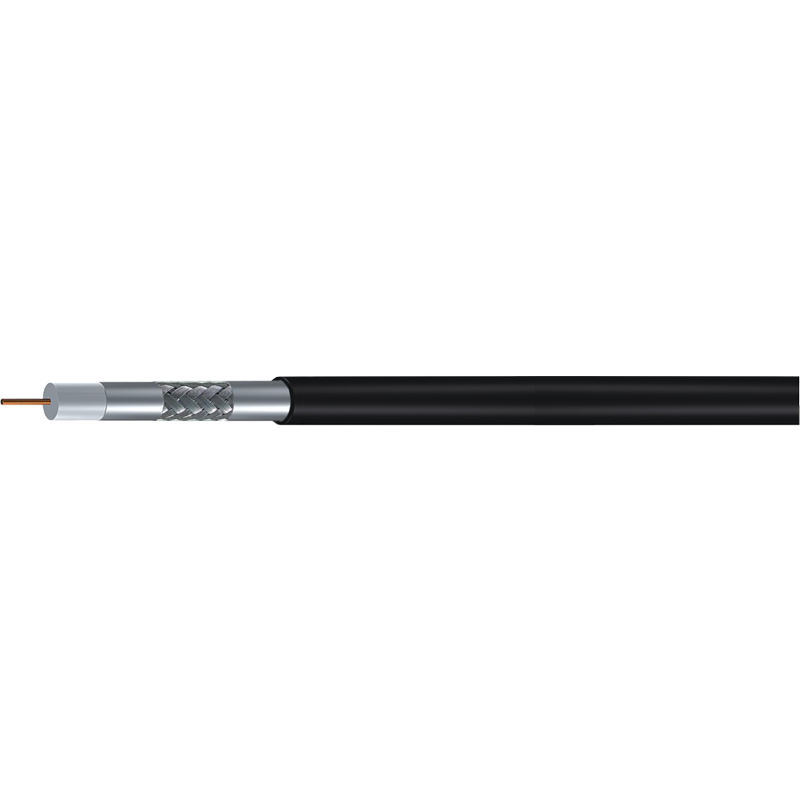 RG6 Tri-Shield 75 Ohm Coaxial CableAdding a second foil layer raises screening effectiveness in LTE and 5G bands, making this the tier installers choose once interference complaints appear. It avoids the stiffness and cost of a full quadshield build.View Product →
High interference and aerial spans
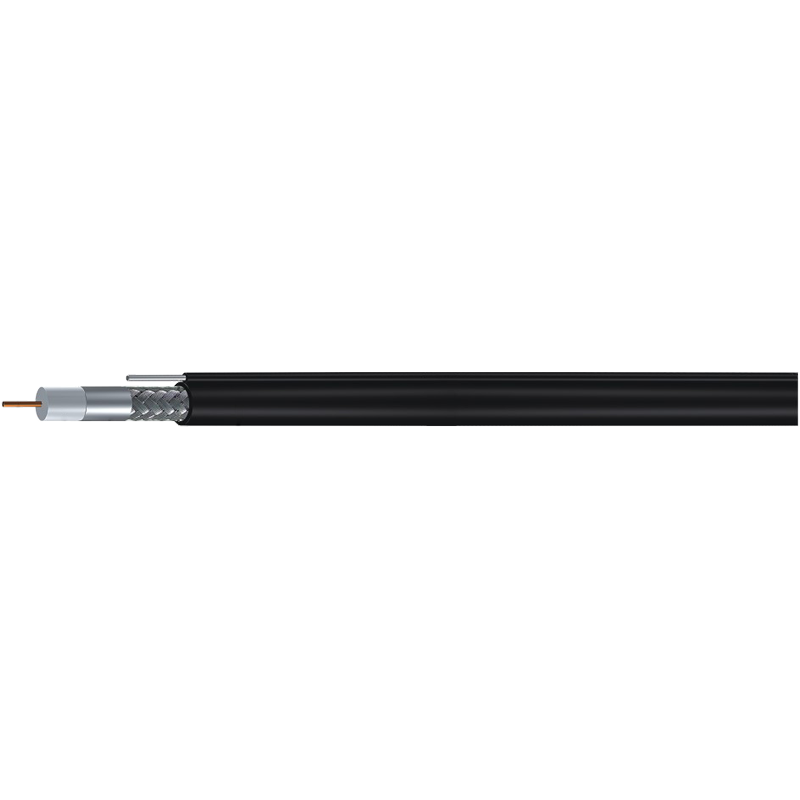
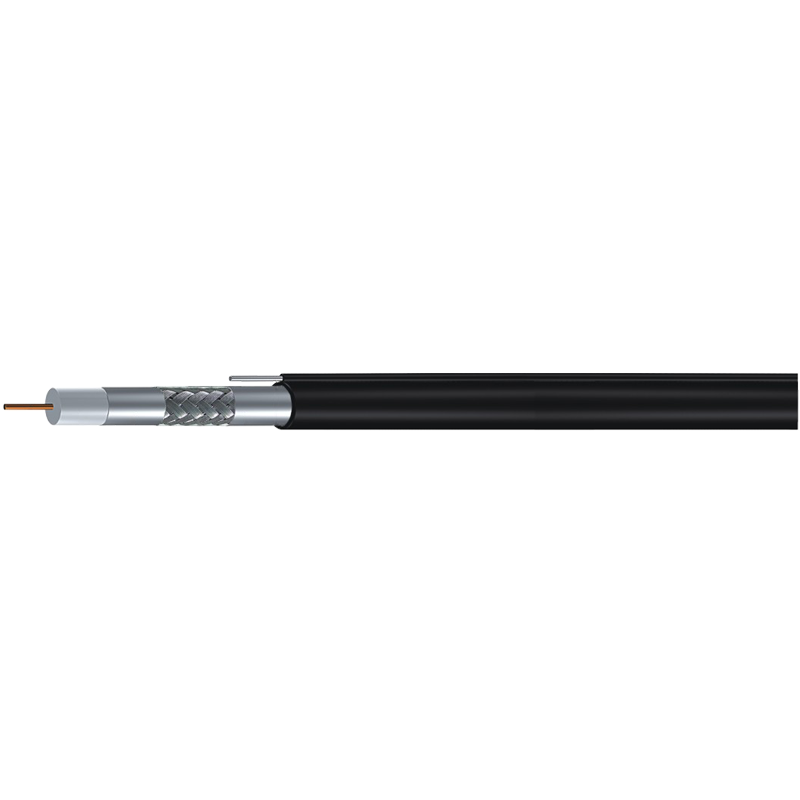
Quadshield justifies its cost where RF is hostile: multi-dwelling buildings full of electronics, streets close to broadcast towers, industrial parks. The second braid adds screening coverage and mechanical toughness in equal measure. Where the run leaves the building — a span to a gatehouse, a detached garage, a rooftop cluster of dishes — the with-messenger version pairs the shield class with a load-bearing steel wire, so wind and ice stress the messenger rather than the coax.
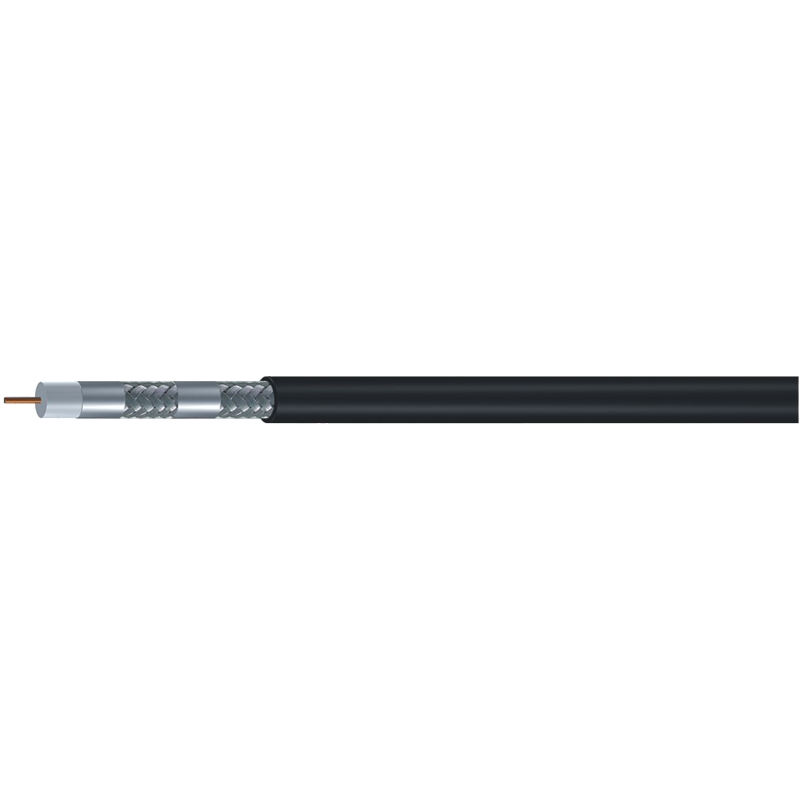
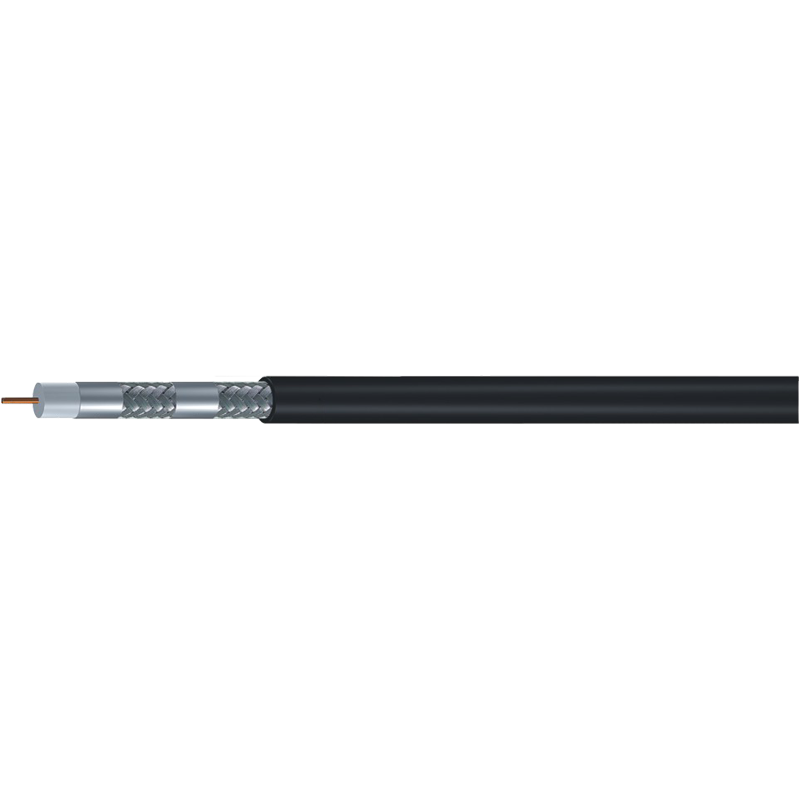
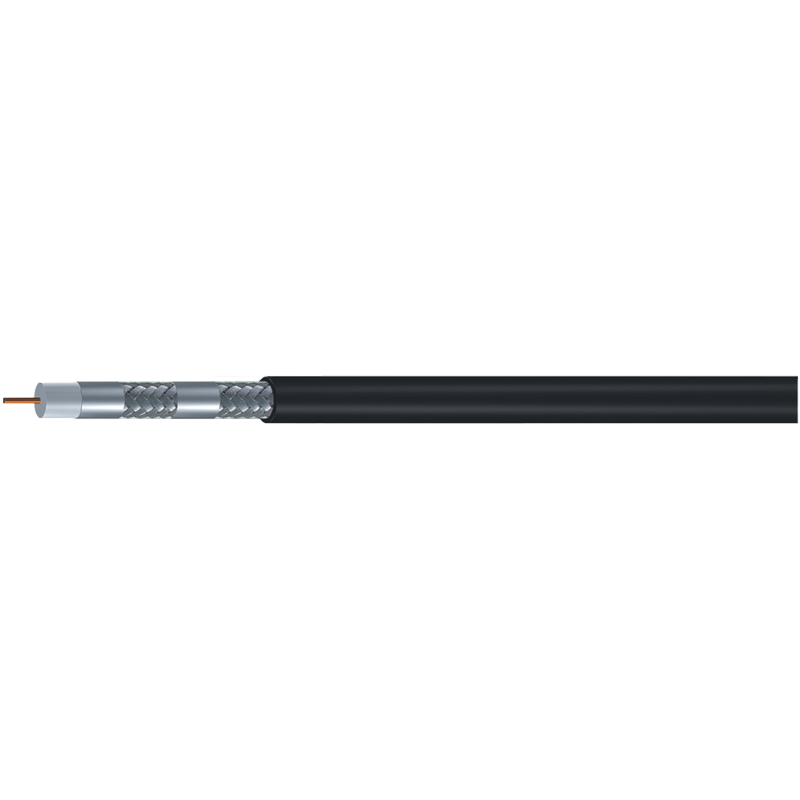 RG6 Quad-Shield 75 Ohm Coaxial CableWith two foils and two braids, this cable suits RF-hostile sites like dense apartment buildings, areas near broadcast towers, and industrial parks, and messenger variants handle outdoor spans to detached buildings.View Product →
Where a 75 Ohm RG6 Run Earns Its Keep
The application list for RG6 reads like the signal map of a modern building:
- CATV and MATV distribution from tap or amplifier to the wall outlet
- Satellite and DTH runs from dish to receiver, including power-passing lines
- Cable modem and DOCSIS drops from the street tap to the subscriber's router
- IPTV and SMATV risers distributing television over a building's coax backbone
- Short CCTV video links, where composite RG6-with-power variants carry video and camera power in one jacket
Two boundaries define when to step outside RG6. Runs longer than roughly 60 to 70 meters lose too much signal level, so RG11 — the same 75-ohm impedance in a thicker, lower-loss body — takes over, and trunk-class 500 and 540 series cables handle network backbones. Dedicated CCTV camera circuits, meanwhile, often justify composite constructions that run video and 12-volt power side by side, halving the cabling work at each camera position.
A Procurement Checklist That Survives the Site Visit
Cable is one of those purchases where the datasheet and the delivered reel can diverge. These checks keep them aligned:
- Impedance and sweep data — confirm the 75-ohm specification and its tolerance, and request sweep test reports for the actual production lot rather than a generic leaflet.
- Conductor material in writing — solid bare copper for power-passing satellite lines; copper-clad steel only for receive-only drops, and only when the datasheet states it.
- Shield construction and coverage — foil count, braid coverage percentage, and whether the foil is bonded to the dielectric.
- Compliance documents — UL or ETL listing for North America, CE and CPR where relevant in Europe, plus RoHS and REACH declarations; in most tenders these are entry conditions, not formalities.
- Jacket and mechanical fit — UV-stabilized jacket for outdoor exposure, a messenger variant for aerial spans, and a bend radius the crew can actually respect while pulling.
- Packaging and traceability — put-up lengths matched to the site's pull plan, drums strong enough for the shipping route, and batch marking that ties any field complaint back to a production lot.
Warning: the most common failure point is not the cable but the junction. Compression connectors must match the cable's actual outside diameter, staples should never bite the jacket, and a crushed or kinked dielectric changes the impedance at that exact spot — a fault no amount of shielding can hide.
Success: sweep each drop across the system's working band after installation and log the result. A recorded baseline turns later troubleshooting from guesswork into comparison, and it protects the installer when a fault appears downstream.
Danger: leave a drip loop before every outdoor entry point and seal the connector. Water that enters an unsealed F-connector migrates along the braid, corrodes it within a season, and usually forces a complete re-pull of the run.
The Bottom Line
The impedance is fixed at 75 ohms; everything else is a judgment call. Match the shield class to the RF environment, the conductor material to the power requirements, and the jacket to the route — then verify every choice on the datasheet rather than on the quotation.
Those checks sit at the center of how we manufacture. As a cable maker whose 75-ohm range runs from standard shield through trishield, quadshield, and messenger variants — produced on gas-injected physical foaming lines and exported to more than 90 countries — Zhejiang CommSpace Cable Co., Ltd. treats lot traceability, certification files, and sweep data as standard practice rather than special requests. Bring the route plan and the site's RF realities, and the cable choice follows from there.