Coaxial Cable Standards
Coaxial Cable Standards, Read Like an Engineer
Impedance classes, RG dimensions, shield builds and the certificates that decide whether a reel can ship — a plain-language guide from a workshop that has been extruding coax since 2001.
Most cable enquiries we receive open the same way: “Could you send pricing on a standard RG6?” The honest answer is that the word standard is carrying a lot of weight in that sentence. It might mean 75 ohm impedance, an RG dimension, a particular shield construction, a fire classification, or all four at once — and the four are rarely spelled out in the same email.
What follows is how we separate those layers on the shop floor and in front of customers, in the order that actually matters when someone is choosing a cable for a project.
What a “Standard” Actually Covers
In day-to-day purchasing conversations, the term covers four distinct things, and they tend to get mixed together in ways that make spec sheets disagree with each other.
- Impedance class — whether the cable belongs to the 50 ohm or 75 ohm family, decided by the ratio between inner conductor diameter and dielectric diameter.
- Dimensional designations — the RG numbers most buyers quote, which began life as military dimension labels rather than performance grades.
- Shield construction — standard, tri-shield and quad-shield builds, plus messenger variants for aerial spans.
- Certification frameworks — UL, ETL, CE with CPR classification, RoHS, REACH and JIS, which govern whether a cable may be placed on a market at all.
Once those four layers are kept apart, a specification becomes readable: impedance tells you the job, the RG number tells you the size, the shield build tells you how much interference protection you are paying for, and the certification tells you whether customs and the local inspector will accept it.
An RG number is a historical dimension label, not a quality grade. Two RG6 cables assembled in different factories can behave quite differently once you push past 1 GHz.
A standard describes what a cable should be. A datasheet describes what this cable actually does on a Tuesday afternoon in July. — the shorthand our engineers use when a tender document turns vague
The 50 and 75 Ohm Divide Comes Before Everything Else
Before arguing about shield layers, settle impedance. It is pure geometry: a dielectric and a conductor sized so the characteristic impedance lands at 50 or 75 ohms. Mixing the two families is the single most common mistake we see in project documentation, and it is usually invisible until the system is powered up.
75 ohm cable belongs to the downstream side of a network — satellite and DTH reception, CATV and MATV distribution, DTV, IPTV, SMATV and video feeds inside a building. 50 ohm cable is the transmit-and-receive side: antenna feeders, LTE and wireless links, two-way radio, test benches.
Our 50 ohm range runs from thin flexible types such as RG174 and RG58 up through RG213 and the larger low-loss flexible series used for longer RF runs.
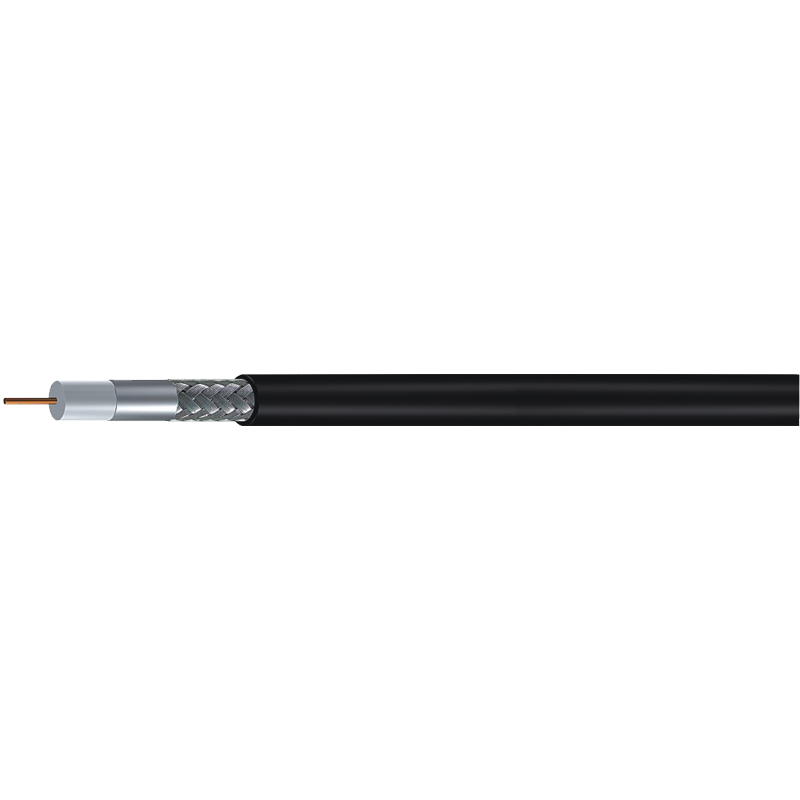 LMR400 50 Ohm Low-Loss Flexible Coaxial CableA flexible 50 ohm low-loss coax for jumper assemblies and antenna feeder runs, offering >90 dB shielding and RG8 replacement positioning.View Product →
The practical consequence of a mismatch is not drama, it is erosion: reflections rise, return loss worsens, and the margin you paid for in the radio quietly disappears across the run.
Putting a 75 ohm television cable into a 50 ohm radio chain rarely damages hardware. It simply spoils the numbers you bought the radio for, and nobody finds out until commissioning day.
Decoding the RG Family Without a Datasheet in Hand
RG designations are shorthand for size and construction, not a ranking. The table below is the orientation map we hand to new sales staff — close enough to start a conversation, never close enough to skip the datasheet.
| Type | Impedance | Center conductor (nominal) | Shield builds available | Where it usually belongs |
|---|---|---|---|---|
| RG6 | 75 ohm | 1.0 mm (18 AWG) | Standard, tri-shield, quad-shield, with messenger | Satellite, CATV, DTV, IPTV and in-building video drops |
| RG59 | 75 ohm | 0.6 mm (22 AWG) | Standard, tri-shield, quad-shield | Short analog video runs, CCTV patch lengths, tight housings |
| RG11 | 75 ohm | 1.6 mm (14 AWG) | Standard, tri-shield, quad-shield, with messenger | Longer distribution drops and aerial spans where loss matters |
| RG58 | 50 ohm | 0.9 mm (20 AWW) | Single and double braid | Short RF jumpers, bench links, mobile antenna runs |
| RG174 | 50 ohm | 0.5 mm (26 AWG) | Single braid | Very small, flexible RF wiring inside equipment |
The RG6 versus RG59 decision is really a decision about run length and space. RG6 carries less loss per metre and suits the drop from the street to the wall plate; RG59 is thinner and easier to route inside a camera bracket or a crowded cabinet, which is why it still holds its place in security work.
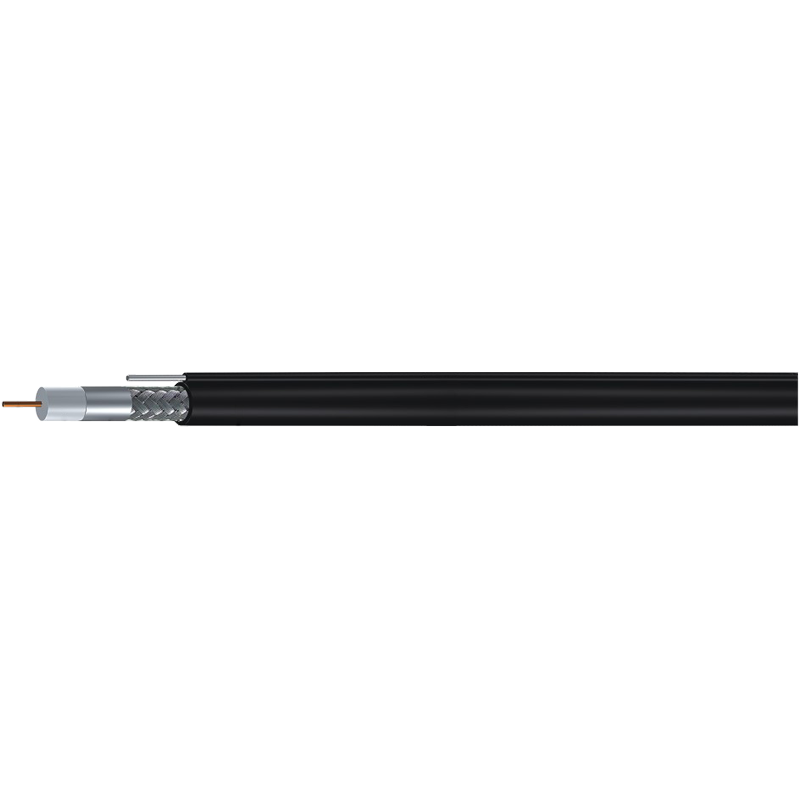
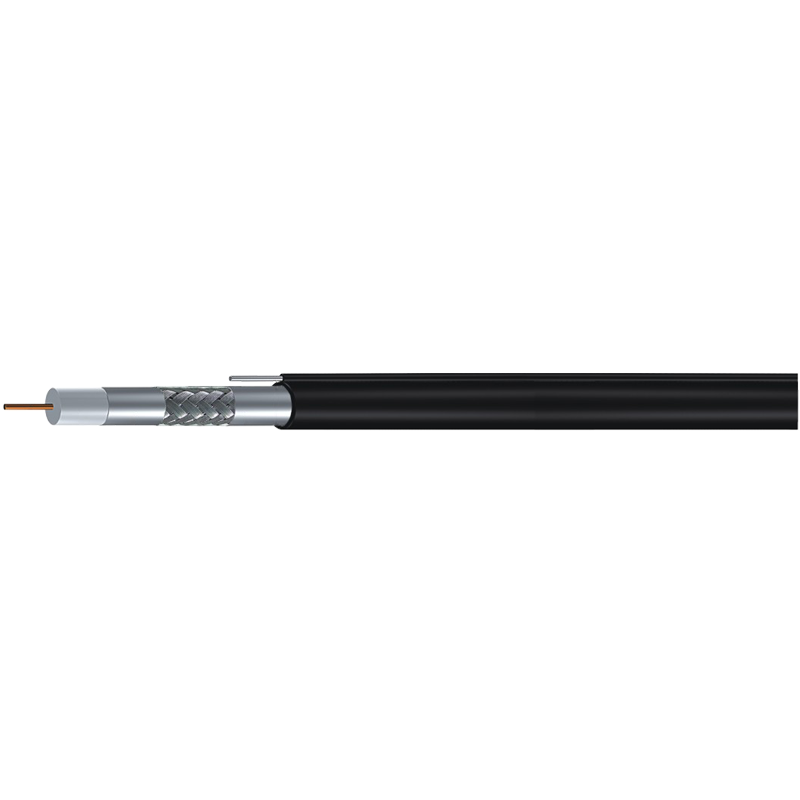
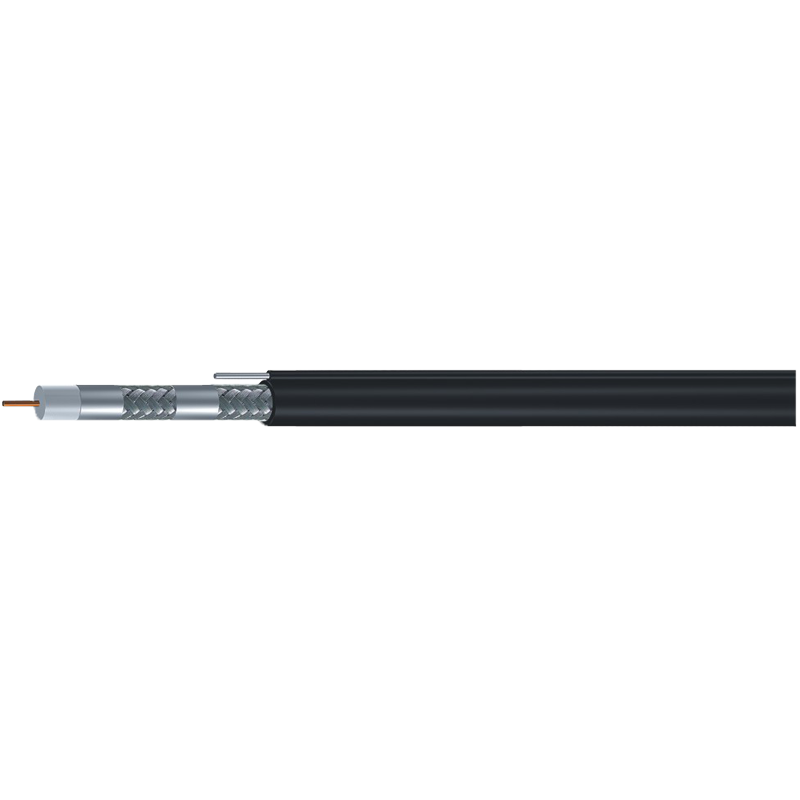
The with messenger versions deserve a note of their own. They carry an additional steel support wire in the jacket, which lets a span hang between poles without a separate bearer — a mechanical standard as much as an electrical one.
Standard, Tri-Shield and Quad-Shield: Choosing by Interference, Not Habit
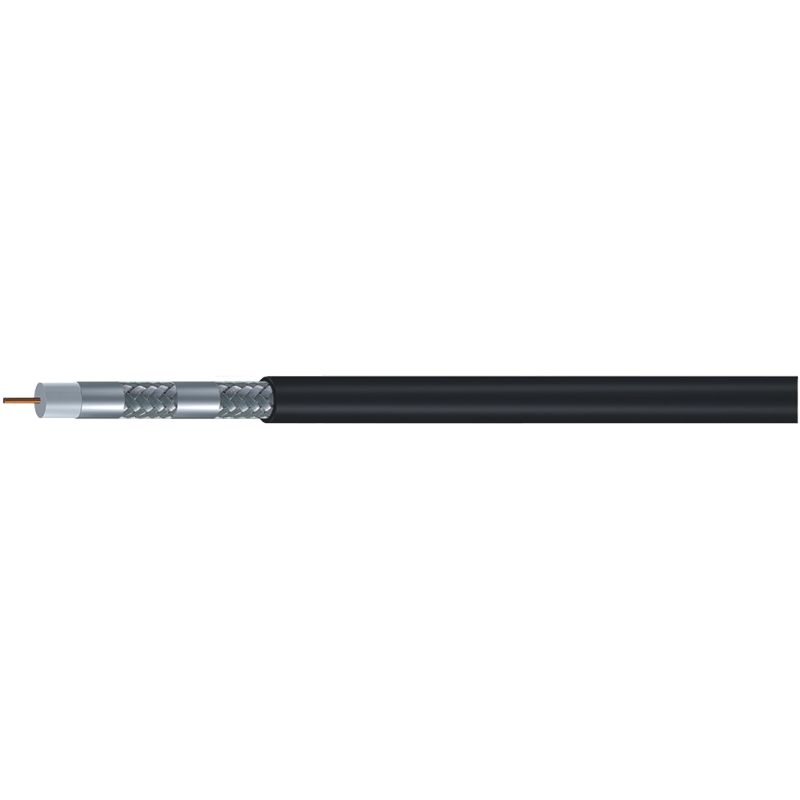
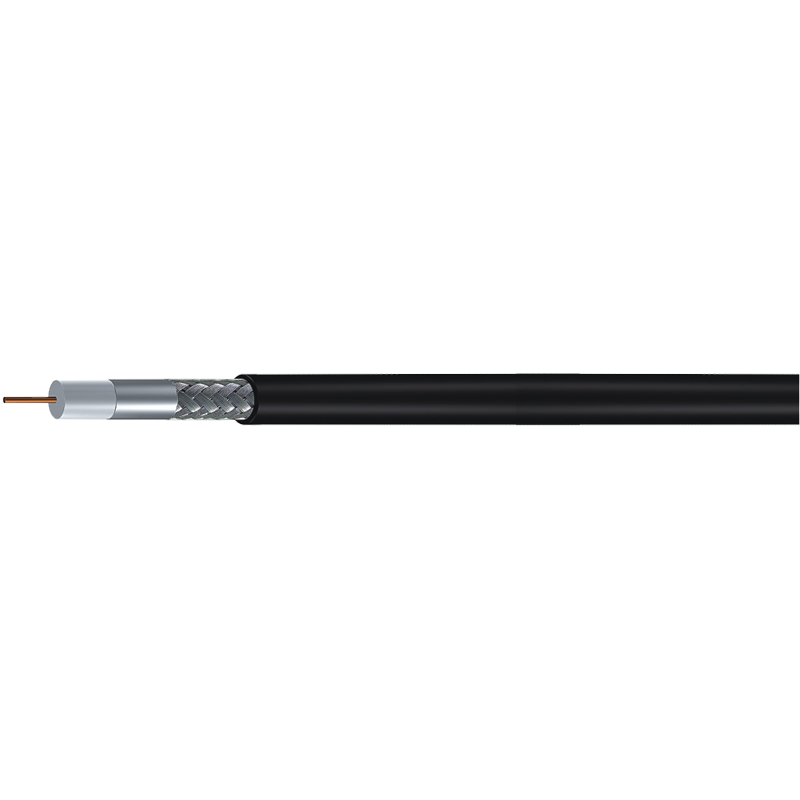
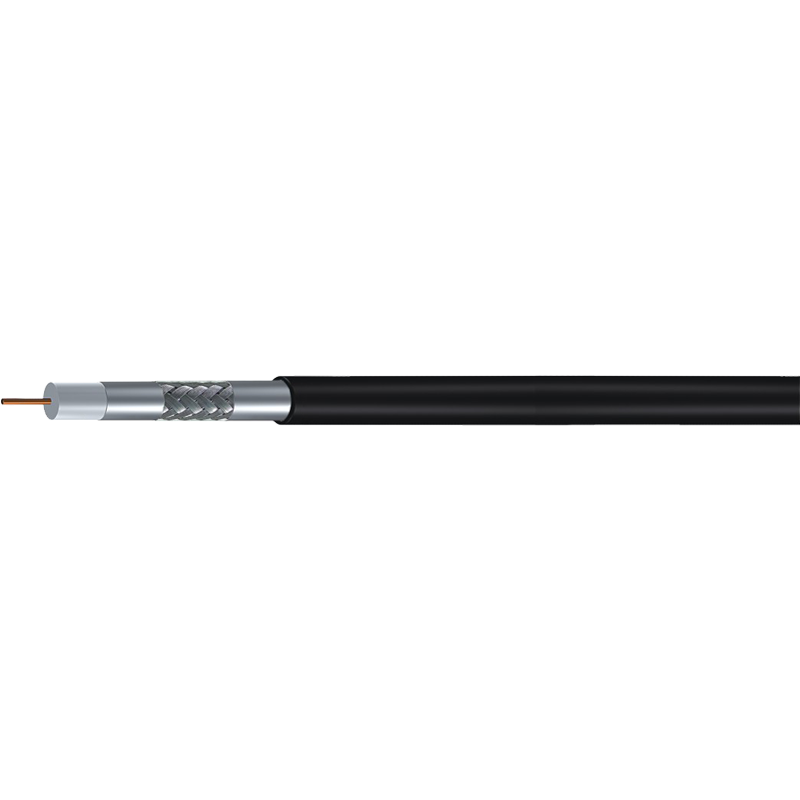
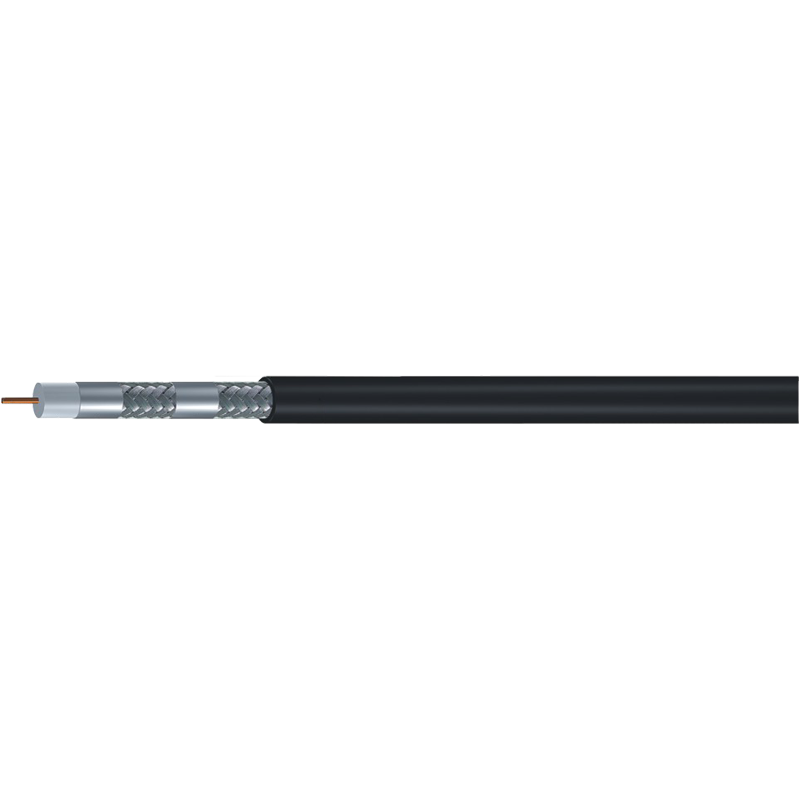
A standard-shield coax pairs one foil layer with one braid. Tri-shield adds a second foil, quad-shield doubles both. Each step raises shielding effectiveness and, just as reliably, raises stiffness, weight, connector cost and assembly time.
Where the extra layers earn their keep: routes running parallel to mains wiring, dense rack rooms, industrial sites with welding equipment, and long aerial spans that collect ingress from the sky. Where they do not: a short indoor jumper between a wall plate and a set-top box.
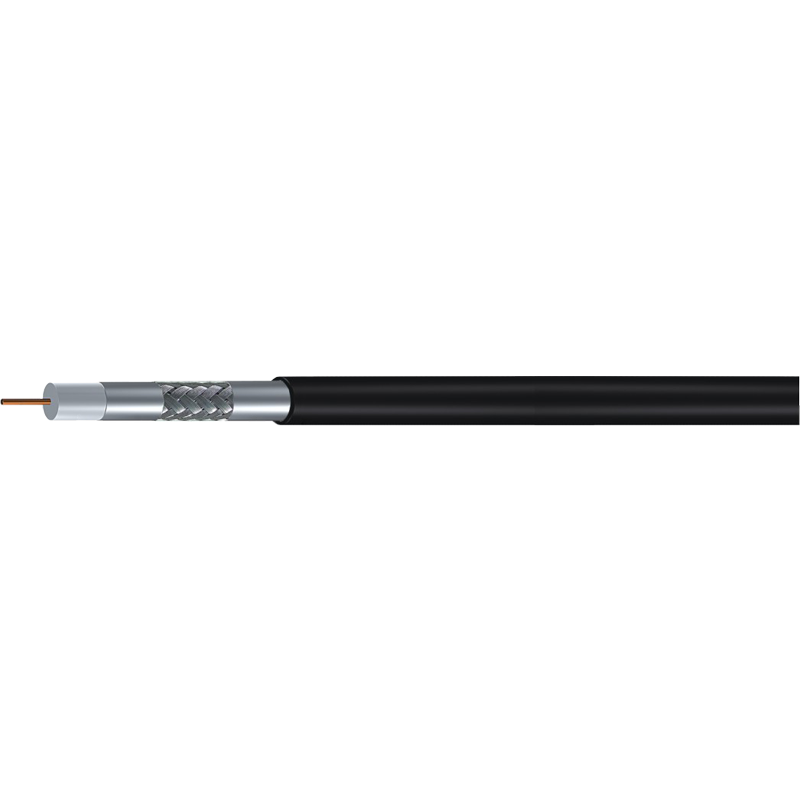 RG6 Tri-Shield 75 Ohm Coaxial CableFor noisy routes and long spans, this tri-shield 75 ohm coax supports satellite, CATV, CCTV and broadband with high screening attenuation.View Product →
We build every 75 ohm size in all three constructions so the choice stays with the installer rather than the catalogue.
Specifying quad-shield out of habit on three-metre indoor leads adds stiffness and cost while removing nothing. Choose the build from the interference environment, not from a neighbouring project’s bill of materials.
The Electrical Numbers Buyers Actually Test
When a technical reviewer opens our files, the argument is rarely about construction language. It is about measured behaviour. These are the figures worth requesting, and the frequencies worth specifying them at.
- Attenuation at the highest channel the system will use — not the convenient 1 GHz reference alone, since loss climbs with frequency.
- Return loss or VSWR, which exposes structural uniformity along the length and the quality of the connector interface.
- Velocity of propagation, which governs timing and phase behaviour across long runs.
- Loop and DC resistance of conductor and braid, decisive wherever power travels over the coax.
- Jacket and dielectric ratings — UV exposure, operating temperature, burial suitability, and the CPR fire class where Europe applies.
Ask for swept data taken from the production batch rather than a golden sample. In our plant the test record follows the reel through an ERP barcode trail, so a question raised six months after delivery can still be traced back to the run that made it.
Certifications: The Part of the Standard You Cannot Negotiate
Certification is where a nice catalogue meets a customs officer. For North America, UL and ETL listing is the entry ticket. For the European Union, CE marking for construction cables runs through CPR classification under EN 50575, alongside RoHS and REACH substance declarations. Japan leans on JIS. None of these are marketing decorations; each is a per-design commitment, and swapping a dielectric compound or jacket material can require the file to be revisited.
This is why the sentence “same as before, but with a cheaper compound” is the one we push back on hardest. The saving is real for one shipment and expensive for the next five years.
A clean document pack travels well: a declaration of performance showing the CPR class, the UL or ETL file reference, RoHS and REACH declarations, and a batch test report. Buyers who receive all four with the first delivery rarely need to chase anything later.
Match the fire class to the tender and the national requirement. A higher class is not automatically “better” if the project specifies otherwise — and substituting upward can still fail an inspection.
Matching the Standard to the Job
CCTV and security systems
Security work has its own convention: video and power in one jacket. Composite constructions save a separate power run to the camera and simplify retrofit jobs where the existing cable route is tight. On long runs, check voltage drop before choosing the size, because the power pair has limits of its own.
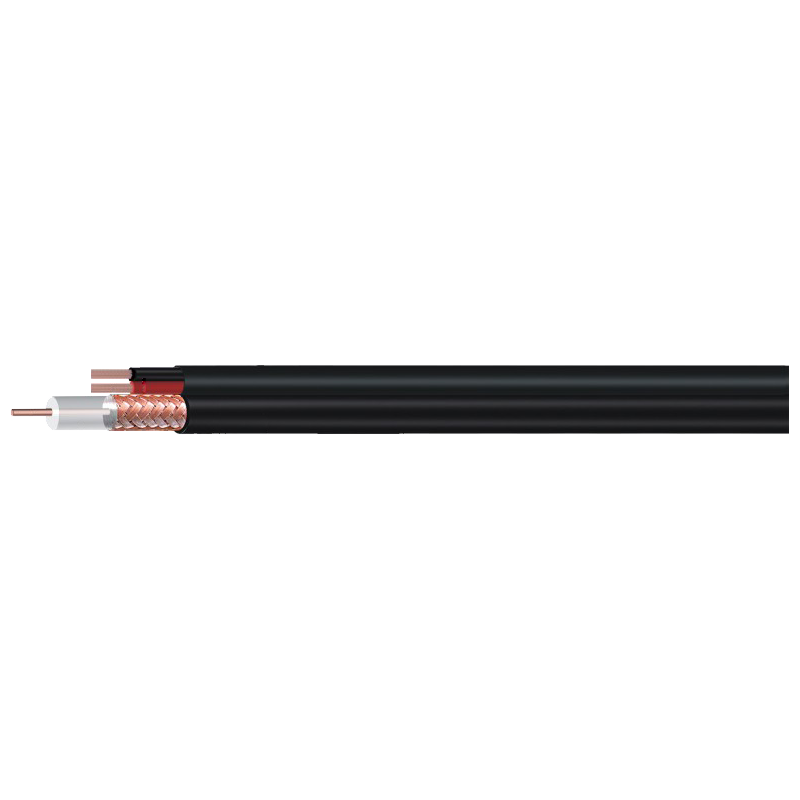 RG59 Composite CCTV Coaxial and Power CableCombines video coax and a power pair in one jacket for CCTV camera retrofits, simplifying routes where a separate power run is impractical.View Product →
Satellite, CATV and video distribution
Here the 75 ohm family rules. RG6 in tri-shield or quad-shield handles the drop to the outlet; RG11 covers longer distribution segments; messenger versions carry the aerial span. Keep the same shield build across a splitter tree so the impedance behaviour stays consistent.
Data and low-voltage systems alongside coax
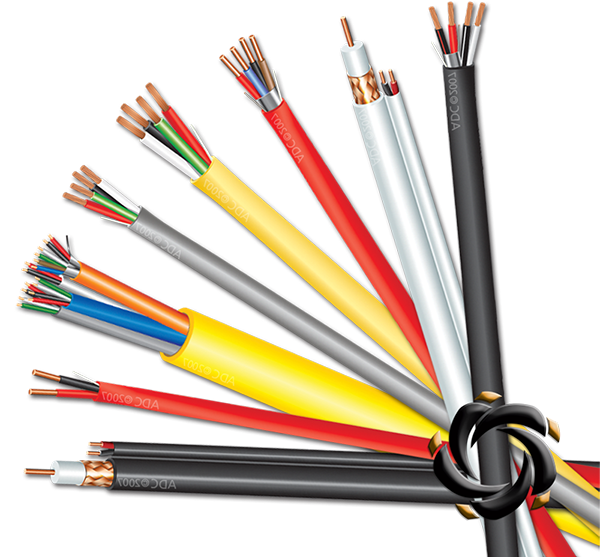
Many projects pair video cabling with structured wiring, so Cat5e and Cat6 in UTP, FTP and SFTP constructions belong in the same conversation, together with alarm, speaker, telephone and composite cables.
Our data cable range covers those levels and shield options in one place, which keeps a bill of materials short.
Trunk and backbone links
Where a network needs a heavier backbone segment, trunk-type coax in the 500 and 540 series, plain or with messenger, is the usual answer. It is a category defined by distance and bandwidth rather than by convenience.
A Practical Selection Checklist
- Confirm the impedance family first, then the RG size.
- State the highest operating frequency, not a rounded average.
- Describe the interference environment honestly — it decides the shield build.
- Measure the longest run and estimate attenuation before ordering.
- Decide indoor, outdoor or aerial, and whether a messenger is needed.
- List the destination markets and the certifications each one requires.
- Ask for batch test data and a declaration of performance with the quotation.
If the tender document is still open to interpretation, this walkthrough on how to choose a coaxial cable covers the same ground from the buyer’s side of the table.
Twenty-five years of extrusion teaches a certain humility about standards. Twelve physical foam lines, 330 braiders and a capacity north of 350,000 kilometres a year are only meaningful if the reel that arrives at your warehouse behaves the way its datasheet promised — which is why our quality department sits between the raw material intake and the final test, and why every batch keeps a traceable record.
Send us the specification you are working from. If we can meet it, we will say so plainly; if a layer of it is unrealistic for the application, we will say that too, and suggest what usually works instead.